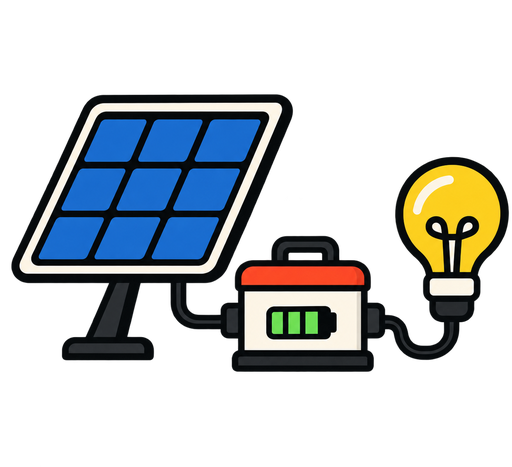
Field reading, R&D-stage prototype
What a European hardware venture learns when a lab-tested solar vaccine fridge meets a rural East African clinic for the first time, and how that evidence changes the next design cycle.

A vaccine fridge that holds temperature in a temperature-controlled European lab is a different device from one that has to hold temperature in a Kenyan clinic with three hours of grid a day, a shared roof, and a nurse whose job it is not to fix it.
A European hardware venture is roughly two years into an R&D programme on a solar-powered vaccine refrigerator designed for last-mile rural health posts. The technology sits at TRL 6–7: it works in a relevant environment, has been demonstrated at pilot scale in a partner-country lab, and is being prepared for a Horizon Europe Innovation Action demonstration at TRL 7–8. The design freeze is scheduled for the next quarter.
The venture's internal signal is favourable. Partner-country validation was clean. The prototype meets the WHO PQS specification on cooling performance. The board is minded to lock the design and move to production tooling.
The Societal Readiness claim in the proposal is SRL 5: validated in the relevant context in co-operation with stakeholders. The evidence behind that claim, at the point the Lab is asked in, is a set of workshops with ministry-of-health counterparts and one week of observation in a peri-urban clinic that already has stable grid. Neither is fieldwork with the nurses, technicians, and community health workers on whom the device will actually depend once deployed.
This is the moment R&D-stage field research earns its cost. Not because the venture is doing anything wrong, but because a design freeze made without evidence from the real deployment context freezes in the assumptions the design team has been quietly making all along.
The specification was built around a "clinic operator" persona. The field reveals four distinct roles: a full-time nurse, a rotating clinical officer, an unpaid community health volunteer who often unlocks the building first thing, and a district technician who visits once every six weeks. Each holds a different piece of the device's success. The persona was one person; the reality is four, and the design decisions that follow are different.
The lab assumes stable grid backup. The clinic has three hours a day, unpredictably. The lab assumes a dedicated roof orientation. The clinic shares a corrugated-tin roof with a community hall, angled away from optimal solar. The lab assumes locked-room siting. The clinic siting is decided by which room has a working door. Each of these is a small design decision made against the wrong constraint. Prototype-in-context sessions surface them within days.
Societal Readiness Level 5 requires evidence of validation in the relevant context in co-operation with stakeholders. Workshop attendance in a capital city does not meet the bar; direct engagement with the nurses, technicians, and communities who will operate and depend on the device does. The Lab's role is to gather that evidence in a form an evaluator can read, per level, so the SRL claim in the Horizon Europe Innovation Action proposal is substantiated rather than asserted.
The output is not a report. It is a ranked list of design decisions to revisit before tooling: a rethought user interface for four operator types not one; a battery-management assumption sized to a three-hour grid, not eight; a service protocol built around a six-week district-technician cadence, not a one-week emergency-response fantasy. Fed back to the venture's own sprint cadence, in time for the next iteration rather than after it.
Field research designed to run alongside the R&D team's own design cycle, on a compressed timeline that ends inside the next iteration, not after it. Six weeks in the field, structured as three overlapping streams.
Stream one, prototype-in-context sessions. Three rural clinics chosen for infrastructure variance: one with the most reliable grid the target market offers, one at the median, one at the hard end. Each hosts the prototype for two weeks under observation, with the actual operators using it in real workflows. The interview guide applied to observed behaviour, not stated preference.
Stream two, structured user work with the four operator roles. Nurses, clinical officers, community health volunteers, and district technicians interviewed separately, with a common structured protocol so their answers can be compared, and a qualitative depth pass on each.
Stream three, the SRL evidence file. A structured record, per SRL level from 1 to 5, of what evidence exists that the level has been achieved. Where the evidence is thin, that is named. Where the evidence contradicts the claimed level, that is named. Delivered in a form a Horizon Europe reviewer can trace and question.
Not a validation report on the device. A design-decision briefing on the next iteration, structured by the design choices the R&D team is still able to change, ranked by the field evidence behind each. The evidence file behind the SRL claim, per level. A revised user model built from four real operators, not one persona. And a plain read of the failure modes the current design most needs to close before the freeze, alongside those it does not.
Turnaround: six weeks in the field, two weeks to a full write-up. Inside the R&D cycle, not after it.
The pattern this reading is built from runs through the Lab's live engagements. the mobility case is the clearest example on the technical side: an electric motorcycle iterated for Nairobi conditions, where the rider's daily arithmetic decided which design choices were viable. Pyropower is the equivalent on the smallholder-hardware side: a portable kiln whose next iteration was designed against direct interviews with the farmers who operated the first one. MiMaji is the service-design equivalent: a water-transparency tool co-designed with the residents whose access to that information had never been mapped.
Each of these engagements is at post-launch stage. The R&D case above is the same discipline applied earlier: before the design freezes, while the evidence can still change it.
For the wider strategic frame on why an R&D team that reads only the technical axis lands in the "dangerous" quadrant (works but is not adopted), see TRL and SRL: The Two Axes of Readiness, and the R&D-service page itself: Research & Development Support.
R&D-stage failure is almost never a failure of the technology. It is a failure of the design assumption that the setting will accommodate the technology, when the setting was never asked. The cost of that assumption is paid twice: once in a launch that reaches fewer people than the funder was told to expect, and once in a redesign that could have been avoided if the field evidence had arrived a quarter earlier. The Lab exists so that evidence arrives on the earlier side.
This is an illustrative composite of the Lab's Research & Development Support service, drawn from the pattern of R&D-stage engagements rather than a single named client. To discuss a study for your own R&D team or consortium, see Contact.